Hyderabad, Mar 30 : While curfew is still on in communal violence-hit areas of Hyderabad, the Bharatiya Janata Party (BJP) on Tuesday said the clashed are a result of the failure if Andhra Pradsh government."Muslim fundamentalist organizations like MIM and others objected to putting up of hoarding of Shri Ram and raised buntings on the eve of Hanuman Jayanti and started attacks on temples, shops, houses and targeted even Gaushala," read a BJP press statement issued by National Spokesperson and MP Prakash Javadekar."Police remained a mute spectator despite complaints and appeals to act. Mr. Satyanarayana, who was coming out of ATM was stabbed to death in the presence of police. Rioters took full advantage of this police laxity and attacked a famous Jain Gaushala in Shamsherjung, where they burnt alive 3 cows by putting grass and petrol on them. "They even burnt cars and beat up people in front of old city police commissioner office. Police till this moment have not arrested the rioters involved in these heinous cow burnings and stabbings. This is comprehensive failure of the police and the Govt. of AP," said Javadekar.The BJP demanded judicial inquiry into the incidents of unprovoked attacks on temples, Hindus and burning of cows in Hyderabad. "This inquiry becomes more imperative in the background of a statement of Congress MP Madhu Yaski that these attacks are part of conspiracy to destabilize present CM K. Rossaih and an admission by city police commissioner that these attacks are premeditated. Both these statements are serious enough to warrant a judicial probe as they hint at a larger conspiracy intended to create communal flare up."Javadekar further said: "AP has a history of such a premeditated communal flare up for settling political scores amongst Congress leaders themselves as witnessed during the regime of M. Chenna Reddy in 1990. Statement of police commissioner is also equally revealing in its contents. "If police commissioner had prior information of this premeditated attacks, why in the first place he did not come up with a plan to prevent such ugly attacks? This must be viewed in the light of the fact that Congress and MIM alliance is ruling Greater Hyderabad Corporation.""BJP condemns the dastardly acts of burning of cows, which shows the cruelty at its worst besides attacks on temples, shops, houses and stabbings. BJP also demands arrest of rioters and brains behind them. BJP demands action against erring police officials," he added.The communal clashes in the city have left one dead and over 80 injured in the past three days. At least 130 have been arrested so far.Fresh clashed were reported on Monday evening at Moghalpura, Shalibanda, Charminar, Aliabad, Falaknuma, Shamsheergunj and Lal Darwaja areas leading to imposition of curfew in 17 police station areas of South Zone.
======================================================
Tuesday, March 30, 2010


Shoaib Malik to wed Sania Mirza

The marriage is sure to attract attention because neighbouring Pakistan and India are longtime rivals, and have fought three wars since 1947.“The news of me marrying to Sania is true,” Malik posted on Twitter on Tuesday. “Inshallah (God willing) will get married in April.”The Pakistan Cricket Board has fined and banned Malik for one year for unspecified disciplinary reasons following heavy defeats in both test and limited-overs series against Australia earlier this year.The 23-year-old Mirza ended a previous engagement to childhood friend Sohrab Mirza in January, citing incompatibility.She issued a statement Tuesday confirming the marriage plan, but asking for privacy.“My wedding Inshallah is going to be the biggest day of my life,” she said. “I have been in the media glare for too long and would appreciate a little privacy at this very personal moment in my life.”Her father, Imran Mirza, said both Sania and Malik will be based in Dubai, in the United Arab Emirates, but continue to represent their countries in their respective sports.“This is a unique case where husband and wife will represent their respective countries in sport,” he said in a statement issued in Hyderabad, India, where the family lives.A local television reported that Mirza, her parents and sister, had applied for a visa at the Pakistan High Commission in New Delhi on Tuesday and were expected to be issued with a visa of three weeks in duration and valid for 60 days.Mirza, a two-time Grand Slam mixed doubles champion, became the first Indian woman to crack the top 40 in the international tennis rankings, reaching a career high of No. 27 in August 2007. At one time, the Muslim player was assailed by conservative elements of the Indian community for competing in short skirts and sleeveless shirts. She has not advanced beyond the first round in her last four tournaments and withdrew from tournaments in Malaysia and the United States in recent weeks due to a wrist injury. She is currently No. 92 in the rankings.Malik, 28, was at the centre of marriage controversy five years ago when he was reportedly broke an engagement with Ayesha Siddiqui, who was from Mirza’s hometown in India.The two had reportedly developed friendship on the internet and Siddiqui’s father had even threatened to take Malik to court.Malik has denied any serious relationship with Siddique.The dashing cricketer was also linked with Indian actress Siali Bhagat, and there were reports of the two meeting confidentially in 2008.News of the Malik-Mirza engagement spread quickly on Tuesday.It’s not the first time that a Pakistani cricketer will be married to a high-profile Indian woman.Former test batsman Mohsin Khan, now the national chief selector, married Indian actress Reena Roy in the 1980s. The marriage later broke down.Newspapers reported that Malik first met Mirza at Hobart, Australia in January, when the Pakistan squad was on tour and Mirza was in the city for a tennis tournament.“It was after this meeting that Mirza’s engagement with his childhood friend broke,” a local Urdu daily reported.Diplomatic relations between Pakistan and India grew more tense after a terrorist attack in the Indian film and financial hub of Mumbai in November, 2008. As a result, the Indian cricket team postponed its scheduled test tour to Pakistan due to security concerns.The Pakistan government refused permission for its players to join the second edition of the Indian Premier League last year before the lucrative Indian domestic league was moved to South Africa.Sporting relations deteriorated further when no Pakistani cricketers were picked up by Indian clubs in this year’s auction for the IPL.Malik played for Delhi Daredevils in the inaugural edition of IPL in 2008.He played 29 test matches for Pakistan and scored 1,517 runs at an average of 36.11. In 190 one-day internationals he has scored 5,141 runs at an average of 34.50 and also took 132 wickets with his off-spin bowling.Malik lost the captaincy of the national team after Pakistan lost a limited-overs series to Sri Lanka at home last year.
======================================================
Curfew continues in tense Hyderabad,
Hyderabad, Mar 30 : The situation in the old city of Hyderabad continues to remain tense, as the curfew has been imposed till 6 p.m. on Tuesday.Deputy Commissioner of Police (DCP) South Zone Madhusudhan Reddy said the curfew that was imposed on Monday evening has been extended till 6 p.m. on Tuesday to avoid any untoward incident, adding that the Class 10 board examination in around 140 centres have been postponed following the incidents of communal violence.Meanwhile, the Central Government has rushed in over 1800 troops in the sensitive areas to maintain law and order and restore peace.Over 130 persons, suspected to be involved in the communal clashes, have been taken into custody so far, police added.The Andhra Pradesh Government on Monday ordered deployment of additional security forces in old Hyderabad city where tension prevails; following overnight clashes between two communities.The Rapid Action Force (RAF) and the state police were earlier deployed in Moosa Bowli, Hussaini Alam, Purana Pul, Begum Bazar, and nearby areas to restore peace following incidents of stone-pelting and assault on religious places, houses, shops and vehicles.Strife started in Moosa Bowli area when the majority community reportedly removed green flags installed by members of the other community and installed saffron ones, instead, during a recent festival. The heated exchanges snowballed into clashes between the two groups.
======================================================
======================================================
Curfew continues in old city: Situation under control

======================================================
Blame game within Congress over Hyderabad riots
Hyderabad, March 30 : In a major embarrassment for the Congress government in Andhra Pradesh, a section of its leaders from Telangana have openly charged their own party colleagues from two other regions of being involved in the communal riots in Hyderabad.Congress MP from Nizamabad Madhu Yashki Goud has said that the riots were a conspiracy by leaders from Andhra and Rayalaseema regions as those opposing the demand for statehood to Telangana had been warning Muslims that communal tensions would rise in the separate state. "It is a conspiracy similar to the one against Chenna Reddy's government to remove him from power," said Yashki referring to the 1990 communal riots of Hyderabad. Rivals of former chief minister Y.S. Rajasekhara Reddy, both within the Congress and in the opposition, had alleged that he was behind the riots to dislodge Reddy from power. Senior Congress legislator Shankar Rao has also alleged that those opposing Chief Minister Rosaiah were behind the riots to defame him and his government. Their allegations evoked sharp reaction from Congress legislators belonging to Andhra and Rayalaseema regions, who demanded disciplinary action against them. Congress sources said party's state unit president D. Srinivas spoke to Yashki, Rao and another MP V. Hanumantha Rao warning them against making any allegations over riots. In the state assembly Tuesday, Rosaiah had to face embarrassing moments when opposition leader N. Chandrababu Naidu referred to the statements made by these Congress leaders and demanded a thorough probe and stern action against those involved. "We are not saying anything but your own party leaders have made certain statements. A thorough probe should be ordered to find out if your own party people are involved or there are other unidentified elements behind the riots," the Telugu Desam Party (TDP) president said amid protests by treasury benches. Earlier, Rosaiah, in his statement, appealed to people to maintain peace and urged all political parties to rise above political differences to cooperate in restoring normalcy in the state. Majlis-e-Ittehadul Muslimeen (MIM) legislator Ahmed Pasha Khadri Tuesday said his party has already given to the government the names of individuals and the party involved in the violence and demanded action against the guilty.
======================================================
======================================================
Oppn forces A P House adjournment over violence in old city

=======================================================
Fresh trouble in communally volatile Old Hyderabad

Shops in the markets around historic Charminar downed shutters as people returned home in panic. State-owned Road Transport Corp (RTC) also stopped plying buses on Charminar-Falaknuma road, the busiest road in the area.Fresh incidents of violence were reported Monday afternoon from Shahali Banda, Moghalpura, Aliabad, Lal Darwaza, Shamsheergunj and other localities near the historic Mecca Masjid.Trouble broke out in Shahali Banda when a group tried to attack a place of worship. Police fired rubber bullets and tear gas and used batons to hit out at the crowds. Clashes were also reported from adjoining localities, shattering the calm prevailed since late last night.Police were having a tough time dealing with some resorting to pelting stones in the lanes and bylanes of the area. Police said additional forces, including the paramilitary Rapid Action Force, were being sent to sensitive areas to control the situation.The trouble restarted just a couple of hours after Andhra Pradesh Chief Minister K. Rosaiah told the state assembly that additional forces from Delhi and neighbouring states were reaching Hyderabad. Home Minister P. Sabita Indra Reddy met public representatives to review the situation.The home minister, who had visited the old city Monday morning, told the state assembly that the situation was under control.Tension gripped the communally sensitive old city after overnight clashes in and attacks on places of worship in several areas. The violence since Saturday night has left over 60 people injured.
Incidents of stabbing, arson, stone pelting, attacks on places of worship, shops and vehicles were reported from over a dozen areas well past midnight Sunday. Police opened fire in the air and lobbed tear gas to bring the situation under control.Director General of Police Girish Kumar, who visited the troubled areas late Sunday, said adequate forces were being deployed to bring the situation under control.Police have imposed prohibitory orders banning the assembly of five or more people in the old city and some communally sensitive areas of the new city.Utter confusion prevailed among students appearing for Class 10 board examinations. The students and their parents were worried over their safety as several exam centres were located in troubled areas, but the authorities went ahead with the examinations amid tight security.The violence, which broke out Saturday night in Moosabowli area of Hussaini Alam following a quarrel between two groups over religious flags, spread to new areas Sunday with mobs armed with stones, sticks and even petrol bombs taking to the streets.Troublemakers attacked passers-by with knives and other sharp-edged weapons in Gowliguda, Falaknuma, Shamsheergunj and Chatrinaka areas after asking them to identify themselves.Women and children were not spared either. About a dozen places of worship were targeted by unruly crowds, who also torched a few shops, a cattle shelter and vehicles.Police Commissioner A.K. Khan has termed the incidents “pre-planned”. Seventy people have been arrested.Though the situation is peaceful and normal life remained unaffected in other parts of Hyderabad and twin city of Secunderabad, police have stepped up security as a precautionary measure.Life in Cyberabad, the IT district housing giants like Microsoft and Google, remained unaffected.
======================================================
Sunday, March 28, 2010
Prohibitory orders 144 CRPC imposed,tension prevails in old city
Hyderabad, Mar.28: Prohibitory orders under Section 144 Cr Pc were imposed in South Zone and parts of West Zone as tension prevailed following clashes between two groups of communites last night and today in these areas.Addressing a press conference tonight City Police Commissioner A K Khan said though tension prevailed in south zone including old city and Ghoshamahal division of the west zone, the authorities had taken all measures to restore normalcy in these areas by deploying additional forces.He said more than 28 people were injured in stone pelting, while 70 trouble makers were arrested. Fifteen cases had been booked so far since last night. Some more trouble makers would be taken into custody tonight.The Special Investigation Team of the CID department was investigating the incidents and the guilty would be punished severly, he said. He said senior police officers were stationed at the sensitive areas and monitoring the situation. He said the way the incidents spread to other areas immediately after reporting the incident in one area had given an indication that it was pre-planned.He said Rapid Action Force (RAF) personnel and state police forces were deployed in Moosa Bowli, Hussaini Alam, Purana Pul, Begum Bazar and surrounding areas to prevent any untoward incident. He said the SMS and cellphones had helped the trouble makers to spread the rumours and clashes to other areas.Forces from outside divisions and state would be deployed in the troubled areas. 30 paltoons would be joining tonight alognwith two RAF companies in addition to Andhra Pradesh Special Police and CRPF.Incidents of stone-pelting and attacks on places of worship, houses, shops and vehicles were reported well past midnight last night. Four vehicles were set afire and about a dozen were damaged by the mob.
======================================================
======================================================
Andhra Pradesh CM asks officials to ensure smooth Hanuman Jayanthi
Hyderabad, Mar 28 : Andhra Pradesh Chief Minister K Rosaiah today directed the police officials to take necessary security measures for peaceful conduct of Hanuman Jayanthi on March 30 following clashes between two communities last night in the Old City.The Chief Minister held a review meeting on the law and order situation in the State particularly in the State Capital, with Home Minister P Sabitha Indira Reddy, Director General of Police R R Girish Kumar and City Police Commissioner A K Khan after his arrival from Krishna District and Inspector General of Police (Intelligence) M Mahender Reddy.The Chief Minister said the government would not compromise on law and order situation and not tolerate if any one created problem.He asked the Police to work in coordination with the Revenue Department and take strict measures to maintain law and order.He urged all communities to cooperate with the the government in view of the ongoing Class X public examinations.He urged all political parties to extend their helping hand to the government in its efforts to maintain law and order and communal peace in the State.He asked the State Home Minister Sabitha Indira Reddy to conduct a meeting with the public representatives and take their suggesitons in view of the last night's disturbances.
======================================================
======================================================
Fresh violence in Hyderabad, restrictions imposed
Hyderabad, March 28 : The communal clashes Sunday spread to more areas in the old city of Hyderabad as police clamped ban on gathering of five or more people and deployed additional forces to bring the situation under control.Police fired shots in the air to disperse clashing groups in Kalapatthar area after a baton charge failed to bring the situation under control while mobs took to streets in Lal Darwaza and Shahali Banda areas Sunday evening, pelting stones and attacking vehicles. Tension gripped the communal sensitive old city as fresh incidents of violence spread panic among people. Nearly 24 hours after the trouble broke out over religious flags in Hussaini Alam area, the disturbances in more areas near the historic Mecca Masjid shattered the day-long peace. Police Commissioner A.K. Khan told reporters that 36 people were injured in violent incidents at various places since Saturday night. "We are on alert in view of the latest incidents and are monitoring the situation from time to time," he said. Paramilitary Rapid Action Force (RAF) and state police personnel were deployed in sensitive areas to maintain peace as Chief Minister K. Rosaiah, who reviewed the situation at a high-level meeting, directed police to deal firmly with trouble-makers. Prohibitory orders under section 144 of criminal procedure code, banning assembly of five or more persons were imposed in the limits of the entire south zone of Hyderabad. Khan said the violence was pre-planned and claimed that some elements creating trouble have been identified. Denying the involvement of any political party, he said a meeting would be held with all elected representatives to seek their cooperation in maintaining peace. Police have registered 15 cases and arrested 70 people for various violent incidents. Khan said a Special Investigation Team (SIT) would probe the cases. Trouble began in Moosa Bowli Saturday night when members of a community were allegedly putting up saffron flags after removing the green flags installed recently during a festival. The heated exchange of word snowballed into clashes between two groups. Incidents of stone pelting and attacks on places of worship, houses, shops and vehicles were reported well past midnight while some people were seen vacating their houses in sensitive areas. Thirteen people, including two scribes, were injured in stone pelting and police baton charge. Two vehicles were set afire and about a dozen others were damaged by the mobs. Police used batons to disperse clashing groups, who were armed with sticks and stones. The incidents took place two days after clashes between two groups in Madannapet area on the same issue. The two communities by and large live in peace and harmony in the city, which has not seen any major communal riot for two decades.
======================================================
======================================================
Modi returns for SIT questioning

The chief minister entered the Special Investigation Team (SIT) headquarters in the old secretariat premises at the appointed time of 9 p.m. after his security had completed the sanitizing of the area.Except media persons and security personnel, no one else was permitted inside the premises.Sources close to the SIT said that the chief minister had already answered 62 of the 68 questions posed to him. The questioning is widely expected to be over by around midnight.Earlier in the day, Modi was questioned by the SIT, eight years after communal riots left over 1,000 people, mostly Muslims, dead in Gujarat.Earlier in the day, Modi chose to appear before the SIT without a lawyer but took a break in between to consult Bharatiya Janata Party (BJP) leader Arun Jaitley, a Supreme Court advocate and leader of opposition in the Rajya Sabha, party sources said.Jaitley had flown here specially for the day.As he emerged after a five-hour questioning Saturday evening, Modi said he was abiding by the Indian constitution and law which are “supreme”.“The Indian law and constitution are supreme. As a citizen and as the chief minister, I am bound by the constitution and the law. Nobody is above the law,” Modi, wearing his trademark crisp white kurta and pyjama, told reporters.Modi is being probed following a complaint by Zakia Jaffri, widow of former Congress MP Ehsan Jaffri killed in the riots, that the chief minister was party to the 2002 widespread violence that swept Gujarat following a train burning in Godhra that killed 59 people in 2002.The SIT is believed to have based most of its questions on issues raised by Zakia in her 100-page petition to the Supreme Court.
According to sources, privy to the SIT questioning, some of the questions asked were:
- Did you give a Gujarat shutdown call following the Godhra incident?
- Who sent ministers to police control rooms during the riots? (Some ministers were alleged to have taken over the control rooms in Gujarat stopping police from taking any action)
- What happened at the Feb 27, 2002 meeting held by the chief minister and other senior officers for review of the situation following the Godhra train burning?
- Do you know about calls made by Ehsaan Jaffri to your office? (the Congress leader had reportedly called up the chief minister’s office several times for help after his house was surrounded by rioters)Zakia has alleged that Modi and his administration aided and abetted the rioters in Ahmedabad’s Gulberg Society where over 60 people were burnt to death. The victims included Jaffri.The first phase of the questioning went on for over five hours.SIT’s A.K. Malhotra, an additional director general of police, led the questioning. Probe panel chief R.K.Raghavan was not present.Modi said he wanted the process to end Saturday.The chief minister said the SIT was made up of officers from outside Gujarat. “They are clearly working under the direction of the Supreme Court.”Modi, one of the top leaders of the BJP, appeared unperturbed though he had been evading being questioned over the riots.“I have spoken at length with the SIT. My conduct should be a fitting reply to my critics.”Zakia Jaffri expressed satisfaction at the fact that Modi appeared before the SIT.“It has taken eight long years but at least he has come. Now that he has played his cards, our lawyers will take it up from here on and we hope some justice will be done,” she said.Union Law Minister M.Veerappa Moily said it was “unfortunate” for a chief minister to be in a situation like that.“It is most unfortunate that Modi landed himself in that kind of a situation. It is not desirable but unfortunately it has happened,” Moily said.The Communist Party of India-Marxist (CPI-M) and the Communist Party of India (CPI) asked Modi to step down on moral grounds.“There is no justification for him to continue as the chief minister. He should resign on moral grounds,” CPI-M leader M.K. Pandhe said.Social activist Teesta Setalvald, who has been fighting for the riot victims, said: “It was an important day for democracy and rule of law when a sitting chief minister has been forced to appear before an inquiry team after various attempts to block justice.”
======================================================
Modi questioning a big step forward: SIT chief

Modi was questioned for nearly 10 hours Saturday in Gandhinagar by the Special Investigation Team (SIT) on a complaint by Zakia Jaffri, widow of former Congress MP Ehsan Jaffri killed in the riots. She has alleged that the chief minister was party to the 2002 violence that swept Gujarat following a train burning in Godhra that killed 59 people.“Definitely, it (the questioning of Modi) was a very big step forward in unravelling few of the mysteries in the matter,” Raghavan told CNN-IBN television channel.He asserted that Zakia Jaffri’s petition was the basis for questioning Modi. “I don’t want to go into details, but broadly speaking, Zakia’s petition was the basic document on which we had to quiz Narendra Modi.”Raghavan added that the investigating officer quizzing Modi would have gone into all the issues related to the matter.He told NDTV channel that it took 10 hours to grill Modi, as a lot of procedures had to be followed. “As he speaks, it has to be put into writing. Accurate reproduction of what he says has to be done, and it is then signed by him,” said Raghavan, former Central Bureau of Investigation (CBI) director.Incidentally, Raghavan was not on the SIT premises when the questioning was going on. “(A.K.) Malhotra is the investigating officer. He is competent. I cannot breathe down his neck. This is CBI practice,” he said.Raghavan asserted that the report on the case would be completed before the Supreme Court’s deadline of April 30.“There may be a few more witnesses to be called, but I am confident that Malhotra will give me the report in advance. It will have to be examined by me and then remitted for legal opinion,” he said.On whether Modi may be recalled for questioning, he said: “That will have to be examined in the evidence. If there is any lacunae, then we can can recall a witness,” he said.
======================================================
Modi questioned for 2002 communal carnage, finally

- Did you give a Gujarat shutdown call following the Godhra incident?
- Who sent ministers to police control rooms during the riots? (Some ministers were alleged to have taken over the control rooms in Gujarat stopping police from taking any action)
- What happened at the Feb 27, 2002 meeting held by the chief minister and other senior officers for review of the situation following the Godhra train burning?
- Do you know about calls made by Ehsaan Jaffri to your office? (the Congress leader had reportedly called up the chief minister’s office several times for help after his house was surrounded by rioters)Zakia has alleged that Modi and his administration aided and abetted the rioters in Ahmedabad’s Gulberg Society where over 60 people were burnt to death. The victims included Jaffri.The first phase of the questioning went on for over five hours. SIT’s A.K. Malhotra, an additional director general of police, led the questioning. Probe panel chief R.K. Raghavan was not present.The questioning was to resume after 9 p.m. and Modi said he wanted the process to end Saturday.The chief minister said the SIT was made up of officers from outside Gujarat. “They are clearly working under the direction of the Supreme Court.”Modi, one of the top leaders of the BJP, appeared unperturbed though he had been evading being questioned over the riots.“I have spoken at length with the SIT. My conduct should be a fitting reply to my critics.”Law Minister M. Veerappa Moily said it was “unfortunate” for a chief minister to be in a situation like that.“It is most unfortunate that Modi landed himself in that kind of a situation. It is not desirable but unfortunately it has happened,” Moily said.The Communist Party of India-Marxist (CPI-M) and the Communist Party of India (CPI) asked Modi to step down on moral grounds.“There is no justification for him to continue as the chief minister. He should resign on moral grounds,” CPI-M leader M.K. Pandhe said.Social activist Teesta Setalvald, who has been fighting for the riot victims, said: “It was an important day for democracy and rule of law when a sitting chief minister has been forced to appear before an inquiry team after various attempts to block justice.”
======================================================
India-Finland sign Agreement on Economic Cooperation
(PIB NEWS) India and Finland have signed an Agreement on Economic Cooperation at Helsinki on 26th March, 2010. The Agreement was signed By Mr Anand Sharma, Union Minister for Commerce and Industry from the Indian side and by Dr Paavo Vayrnen, the Minister for Foreign Trade and Development from the Finnish side. Speaking on the occasion, Shri Sharma said that the new Agreement will raise the level of Economic and Trade Cooperation between the two countries to a new and higher level. The Agreement seeks to replace an earlier Agreement which was signed way back in 1967 under the GATT regime. He said that the world has moved far ahead now and both the countries offer vast areas of opportunity which can be suitably tapped keeping in view the complimentarity of our sectors. The highly organized high-end technology sectors of Finland can develop synergy with the highly skilled and educated work force of India. The Agreement seeks to deepen the engagement between the two countries through exchanges of investors, information and experts and also by developing opportunities for the two countries by exploring joint economic possibilities in third countries. A Joint Commission consisting of experts will be set up under this Agreement to identify new business possibilities and also to identify and remove hurdles which could hamper mutual economic cooperation between the two countries. The two sides also decided to set up three Joint Working Groups in the areas of Innovation, Clean Technology and waste management and skill Development and Training. The Indian Commerce and Industry Minister has been accompanied by a high level business delegation under the leadership of shri Rajan Bharti Mittal, President of FICCI and included some of the leading industrialists of India. Earlier the two Ministers also chaired a business roundtable on 25th March 2010. Business leaders present from both sides exuded keenness to collaborate in high technology sectors. Shri Sharma observed that areas of infrastructure, clean energy, bio-pharmaceuticals, medical electronics, health and skill development offer enormous potential and stated that the Indian MSME sector and Finnish small industries should use each other’s strengths to make India a manufacturing hub for tech-rich industries and invited the Finnish industry to Invest in Institutes of Excellence and skill imparting centres in India. This was an area that India would be keen to commence work on immediately, he said. During the two day visit shri Sharma also held bilateral talks with Finnish Minister of Economic Affairs and employment Mr. Mauri Pekkarinen, and Dr Paavo Vayrynen, Minister for Foreign Trade and Development on areas of strategic and economic importance for the two countries. =======================================================
Tension in old city of Hyderabad after religious clashes
Hyderabad, March 28 : Parts of the old city of this Andhra Pradesh capital Sunday remained tense after religious clashes between two groups, which left 13 people injured Saturday night.Paramilitary Rapid Action Force (RAF) personnel and state police forces were deployed in Moosa Bowli, Hussaini Alam, Purana Pul, Begum Bazar and surrounding areas to prevent any untoward incident, police said. Police commissioner A.K. Khan, who visited the old city late Saturday night, Sunday said the situation was now peaceful with no fresh incident. Incidents of stone-pelting and attacks on places of worship, houses, shops and vehicles were reported well past midnight while some people were seen vacating their houses in sensitive areas. Thirteen people, including two journalists, were injured in stone-pelting and police lathicharge. Two vehicles were set afire and about a dozen were damaged by the mobs. Trouble began in Moosa Bowli when members of a community were allegedly putting up saffron flags after removing the green flags installed recently during a festival. The heated exchange of words snowballed into clashes between the two groups. Police used batons to disperse clashing groups armed with sticks and stones. Local legislators of Majlis-e-Ittehadul Muslimeen (MIM) and leaders of the Bharatiya Janata Party (BJP) reached the areas. MIM legislator Ahmed Pasha Khadri alleged that police not only remained a mute spectator to the attacks on the houses of the minority community but also resorted to unprovoked baton charge on youth. However, BJP leader G. Ramaswamy said some people created trouble by taking objection to the installation of saffron flags on the occasion of Hanuman Jayanthi. The minority community was not stopped from putting up flags during their festival, he added. The two communities by and large live in peace and harmony in the city, which has not seen any major communal riot for two decades.
=======================================================
=======================================================
Saturday, March 27, 2010
APPCC chief pays rich tributes to former Deputy CM Koneru
Andhra Pradesh Congress Committee (APCC) president D Srinivas today paid rich tributes to former Deputy Chief Minister Koneru Rangarao at the Congress Committee office 'Andhra Ratna Bhavan' here.After unveiling the portrait of Koneru and addressing a condolence meeting organised by the City Congress Committee, he said the death of Koneru on March 15 was a great loss to the party and to the down-trodden people of the state. He fought till his last for the welfare of Backward classes and Dalits and discussed frankly on people problems in the party and cabinet meetings, Mr Srinivas said.Earlier, he visited Kanakadurga temple atop Indrakeeladri hills and offered prayers to goddess Kanaka durga.
======================================================
======================================================
Modi appears before SIT

=======================================================
I&B State Minister Distributed "Akashvani Annual Award"

(Photo by PIB No:CNR-30977)
======================================================
Friday, March 26, 2010
Muslims hail court order on Andhra quota, want states to follow
Hyderabad/Patna, March 26 : The Supreme Court order restoring four percent quota for backward class Muslims in government jobs and education in Andhra Pradesh has come as a relief for students aspiring for professional courses and has been welcomed by the community, which now wants more to states implement it.Students, who feared they would lose an academic year because the Andhra Pradesh High Court last month quashed the quota, were elated with the Supreme Court's interim order. The court Thursday observed there was nothing wrong in providing a quota for Muslim backward classes. Majlis-e-Ittehadul Muslimeen (MIM) president and Hyderabad MP Asaduddin Owaisi, who is spearheading a campaign for the restoration of Muslim quota in the state, termed the court verdict as "remarkable". "This is our first victory and will save the academic year of Muslim students," he said. The court order will enable students from 14 backward Muslim groups in Andhra Pradesh, where the community accounts for 9.2 percent of the 77 million population, to avail of the reservation benefits for the fourth consecutive year. Since a constitution bench of the apex court will take up the hearing in August, admissions to most of the professional courses would be completed by then. "The court order will encourage us to do well and we can continue to avail of the quota benefit," said Mohammed Saifullah, a Class 12 student who hopes to get admission to an MBBS course. In the past three years, about 30,000 Muslim students were admitted to various professional courses and higher education and nearly 3,000 candidates were recruited in government jobs. The apex court judgment has also raised hopes among Muslim students appearing for the Andhra Pradesh Public Service Commission (APPSC) examinations, where reservations have not only benefited Muslims in getting lower cadre government jobs under Group II but helped them to occupy higher administrative positions too, like that of deputy collectors. The beneficiaries and community leaders give credit for this to late chief minister Y.S. Rajasekhara Reddy, who provided reservation soon after coming to power in 2004. Fulfilling his election promise, YSR had provided five percent quota to Muslims through a government order in 2004. But the high court quashed it on petitions by some individuals. However, on the court's advice, the government reconstituted the backward classes commission and directed it to conduct a detailed survey of the socio-economic conditions of Muslims. On the commission's recommendations, the government issued an ordinance in 2005 for five percent reservation, and the assembly subsequently passed the legislation. However, it was quashed by the high court on grounds that this would exceed the 50 percent quota limit set by the Supreme Court. The government then issued another order in 2007 providing four percent quota in government jobs and educational institutions for backward classes among Muslims. A seven-judge bench of the high court Feb 8 quashed the Andhra Pradesh Reservation for Socially and Educationally Backward Classes of Muslims Act of 2007, this time saying reservations cannot be extended on religious basis. Muslim leaders in Bihar, where the community accounts for 16 percent of the state's 83 million people, also welcomed the apex court order and called on various state governments to similarly extend the benefits of reservation to the community. Terming it a "historical decision", the influential Patna-based Imarat Shariah's chief Maulana Syed Nizamuddin told IANS this would have a long-term effect on the development of Muslims in India. The government should provide reservation for 15 years to backward members of the Muslim community as well as other categories of Muslims, said Nizamuddin, who is also the general secretary of the All India Muslim Personal Law Board. Dalit Muslim leader Irshadul Haque said that reservation for Muslims, particularly backward members, will help empower them. Maulana Anisur Rahman Qasmi, chairman of the Bihar Haj Committee, said the Muslim community deserves reservation for their empowerment. Gulam Ghaus, a legislator of the opposition Rashtriya Janata Dal, said that Muslims will have to fight for a similar reservation in other states. "Muslims are as backward and poor as Dalits in the country. Reservation is a tool to push them ahead," he said.
=========================================================================
=========================================================================
Supreme Court order on Muslim quota a relief for students
Hyderabad, March 26: The Supreme Court order restoring four percent quota for backward Muslims in government jobs and education in Andhra Pradesh has come as a big relief for students aspiring for admission into professional courses in the next academic year.The students, who were afraid of losing a year due to last month's Andhra Pradesh High Court order quashing the quota, were elated with the interim order of the Supreme Court, which Thursday observed that there was nothing wrong in providing a quota for Muslim backward classes. Students from 14 backward groups in the Muslim community hope to avail of the reservation benefit for the fourth consecutive year. Since a constitutional bench of the apex court will take up the hearing in August, admissions to most of the professional courses would be completed by then. "The court order will encourage us to do well and we can continue to avail of the quota benefit," said Mohammed Saifullah, a Class 12 student who hopes to get admission in a MBBS course. Majlis-e-Ittehadul Muslimeen (MIM) president and Hyderabad MP Asaduddin Owaisi, who is spearheading a campaign for the restoration of Muslim reservation, termed the court verdict as and #65533;remarkable'. "This is our first victory and will save the academic year of Muslim students," he said. In the past three years, about 30,000 Muslim students were admitted into various professional courses and higher education and nearly 3,000 candidates were recruited in government jobs. Muslim leaders view the quota as a boon to ameliorate the socio-economic conditions of the community. The Supreme Court judgement has also raised hopes among Muslim students appearing for the Andhra Pradesh Public Service Commission (APPSC) examinations. The reservations have not only benefited Muslims in getting lower cadre government jobs under Group II but helped them to occupy higher positions like that of deputy collectors. As many as seven Muslims, including two girls, got Group I postings in 2008. The beneficiaries and community leaders give credit for this to late chief minister Y.S. Rajasekhara Reddy, who provided reservation soon after coming to power in 2004. "Not a single day passes when Muslims do not feel the absence of Rajasekhara Reddy," MIM leader Akbaruddin Owaisi told the assembly this week while speaking on welfare schemes launched by YSR, who died in a helicopter crash in September last year. Fulfilling his election promise, YSR had provided five percent quota to Muslims through a government order in 2004. But the high court quashed the same on petitions by some individuals. However, on the court's advice, the government reconstituted the backward classes commission and directed it to conduct a detailed survey of the socio-economic conditions of Muslims. On the recommendations of the commission, the government issued an ordinance in 2005. Subsequently, the assembly passed legislation for five percent reservation. However, the high court set aside the legislation on grounds that this would exceed the 50 percent quota limit set by the Supreme Court. So the government issued an order in 2007 providing four percent quota in government jobs and educational institutions for backward classes among Muslims. A seven-judge bench of the high court Feb 8 quashed the Andhra Pradesh Reservation for Socially and Educationally Backward Classes of Muslims Act of 2007 saying reservations cannot be extended on religious basis. According to the 2001 census, Muslims constitute 9.2 percent of the 77 million population of Andhra Pradesh.
======================================================
======================================================
New emigration law to safeguard interests of Indians abroad
The Ministry of Overseas Indian Affairs (MOIA) is drafting a new emigration legislation to safeguard the interests of Indians settled abroad, union Minister of State for Planning and Parliamentary Affairs V.Narayanasamy Thursday said.Promising to pursue a pro-active policy to transform the emigration system and empower emigrants through systematic interventions of the MOIA, he said the government is doing its best to protect the Indian emigrants from unscrupulous elements.Addressing a gathering here after presenting visa papers to 200 immigrants to Canada at an ceremony of World Wide Immigration Consultancy Services (WWICS) here, Narayanasamy stressed the need for seeking legal route for emigration.Noting that international migration was an important dimension impacting economic relations between the developed and developing countries, he hoped that the 200 new immigrants will bring laurels to the country by their hard work.WWICS provides global resettlement solutions for emigration to countries like Canada, Great Britain, New Zealand, Australia under the skilled worker, business and study visa categories.WWICS chairman B.S. Sandhu revealed that the Canadian government is reconsidering its priority occupation list (POL) of 38 occupations and a new list will come into effect from May 1 this year. He advised the aspirants to file their papers before May 1, if their occupation is already listed in the POL.He said that since its formation in 1993, WWICS has settled nearly 400,000 people abroad.
======================================================
======================================================
Thursday, March 25, 2010
NTPC pays highest ever interim dividend of Rs.2473.64 crore

(PIB NEWS) March,25, NTPC Limited paid highest ever interim dividend of Rs. 3 per equity share being 30% of the paid-up equity share capital of the Company amounting to Rs.2473.64 crore for the Financial Year 2009-10. Out of this, an amount of Rs.2090.21 crore was paid to Government of India holding 84.5% of NTPC’s paid up equity. An advice confirming credit of Rs. 2090.21 crore into Government’s account was presented by Shri R.S.Sharma, CMD, NTPC to Shri Sushilkumar Shinde, Union Minister of Power on 24.3.10 in New Delhi. Shri H.S Brahma, Secretary (Power) and other senior officials from Ministry of Power and NTPC were present on the occasion. This is the 17th consecutive year that NTPC has declared dividend ,
=======================================================
Andhra Pradesh Muslim quota gets apex court nod
New Delhi, March 25: The Supreme Court Thursday temporarily allowed job quota for backward Muslims in Andhra Pradesh, but left a final decision on the matter to a constitution bench.With this, the Andhra Pradesh government is likely to go ahead with its proposal of reserving four percent of government jobs for Muslims. A bench of Chief Justice K.G. Balakrishnan and Justices J.M. Panchal and B.S. Chauhan, has referred the issue to the constitution bench to examine the validity of the decision. The order was given on a Special Leave Petition (SLP) filed by the state government against an order of the Andhra Pradesh High Court that had earlier struck down the provision as being unconstitutional. The order from the apex court comes a day after Minorities Affairs Minister Salman Khurshid said the central government would help Andhra Pradesh in implementing the quota if the Supreme Court directed it to do so.
======================================================
======================================================
APUWJ condemns 'false' case against ABN-Andhra Jyothi channel
Hyderabad,Mar 25:The Andhra Pradesh Union of Working Journalists (APUWJ) has strongly condemned the 'false' case lodged against the Managing Director of ABN-Andhra Jyothi news channel by Praja Rajyam Party (PRP) activists.In a statement issued yesterday, APUWJ President D.Somasundar and General Secretary Y.Narender Reddy said the case filed by the PRP activists was false and a facade to hide their own criminal and undemocratic attacks on the channel's office.The Journalists' Union also urged PRP President Chiranjeevi to withdraw the case against the channel.The PRP activists had filed a case against the Managing Director and some other channel employees in Banjara Hills police station alleging that they were beaten up when they had gone to the channel's office on Monday.
======================================================
======================================================
IT Minister Presented The "LIMCA BOOK OF RECORDS"

CM-inaugurate legislatures cricket tournament,
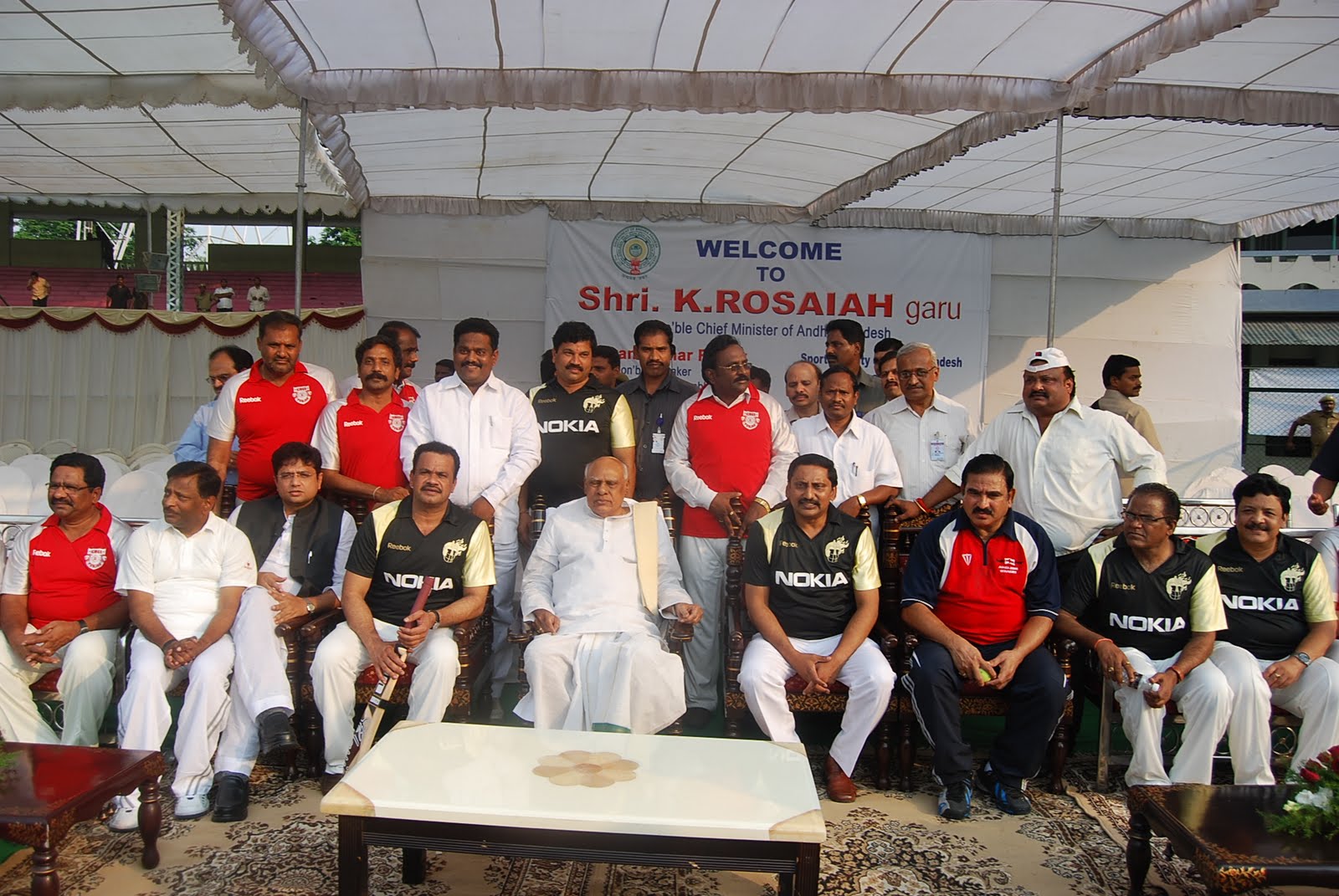
Speaker Andhra Pradesh Legislative Assembly N.Kiran Kumar Reddy inaugurating Cricket Tournament between MLA"S and MLC's (Photo by RSJThomas.Hyderabad) ==============================================
Wednesday, March 24, 2010
Telangana supporters heckle Naidu outside jail

=======================================================
Journalists demands stringent acts on media attacks
Tirupati, Mar 24 : Denouncing the attack on ABN Andhra Jyothi channel office by the PRP activists at Hyderabad. journalists yesterday took out a protest rally in the temple town.As many as 100 journalists including photographers led by the APUWJ leader Mr Dinesh, APUWJF leader Mr Delhibabu,Sakhi bureau Mr Nagesh and Visalandra bureau Mr T Janardhana Reddy, gathered at the Tirupati Press Club from where they took out a huge protest rally to the busy four pillar junction besides raising slogans against the political attacks on the media.Later, speaking to the press, they demanded the government to bring stringent acts on the media attacks.The persons responsible in the attack should be arrested, they added. ======================================================
Telangana supporters heckle Naidu outside jail
Pro-Telangana activists Wednesday heckled Telugu Desam Party president N. Chandrababu Naidu when he visited a jail here to meet TDP leaders arrested for attacking advocates who had disrupted a party meeting.Tension prevailed outside Cherlapally jail on the outskirts of the city as activists of Telangana Joint Action Committee (JAC) stopped Naidu's convoy as he came to call on TDP corporators and other leaders. Raising slogans of "Jai Telangana", the protesters asked Naidu to make his stand clear on the issue of Telangana. They entered into an argument with TDP activists who came to the rescue of their leader. The two groups clashed as police intervened and arrested pro-Telangana protesters. The former chief minister met two TDP corporators and another party leader in jail. They were arrested early this month for an attack on lawyers. The TDP leaders had attacked advocates March 6 when they had disrupted Naidu's speech at a party programme, demanding that he make his stand clear on the issue. Few advocates were injured in the incident, which triggered massive protests by pro-Telangana lawyerss. They even prevented other lawyers from defending the TDP leaders arrested in the case. Naidu had rejected the demand of the all-party JAC to tender an apology to the advocates, which finally led to JAC convenor M. Kodandaram expelling Telangana leaders of TDP from the apex body fighting for a separate Telangana state. (Way2online)
======================================================
======================================================
Bharat Stage-IV fuels-Petrol and diesel Launched in Delhi

====================================================== (PIB NEWS) The environment friendly Bharat Stage-IV (Euro-IV) auto fuels namely petrol and diesel were launched in Delhi today. This, together with CNG which mandatory for public transport, makes Delhi having supply of the cleanest auto fuels in the world. To mark the occasion, Shri Murli Deora, Minister of Petroleum and Natural Gas, Smt. Sheila Dikshit , Chief Minister of Delhi and Shri Jitin Prasada, Minister of State for Petroleum and Natural Gas flagged-off the truck tank –lorries of IOC, HPC and BPC from Bijwasan Oil Terminal in Delhi, were through video-conferencing arranged at the SCOPE Auditorium near CGO Complex in Delhi. Among other dignitaries Petroleum Secretary Shri S Sundareshan, CMD IOC and senior officers of Petroleum Ministry and Oil PSUs and oil industry representatives were also present. Speaking on the occasion Shri Deora informed that arrangements have been made to ensure availability of Petrol and Diesel conforming to Bharat Stage-IV norms from 1st April, 2010 in all the 13 cities specified in the road map, namely, 4 Metro cities, Hyderabad, Bangalore, Lucknow, Kanpur, Agra, Surat, Ahmedabad, Pune and Sholapur. Shri Deora also said that the launch of new and upgraded fuels will enable the citizens of Delhi and the NCR to use environment friendly transportation fuels of international standards. He recalled that 10 years back Ministry of Petroleum & Natural Gas, in association with Delhi Govt., started an ambitious programme to supply CNG for all Public Transport vehicles along with PNG for domestic use. Delhi was one of the world’s 10 most polluted cities, with vehicles contributing about 65 per cent of the polluting emissions. Shri Deora pointed out that today, Delhi has now transformed itself into a show piece with improved and safe air quality and its entire public transport fleet converted to run on Compressed Natural Gas (CNG) at a scale unparalleled anywhere else. “IGL provides CNG to nearly 3,50,000 vehicles, including about 2 lakh private vehicles. This effort by IGL has significantly contributed in reducing pollution in Delhi. The launch of BS-IV fuels will further strengthen the State Government’s efforts for a cleaner and greener city,” he added. He also complimented Public Sector oil marketing companies – Indian Oil Corporation, Bharat Petroleum Corporation and Hindustan Petroleum Corporation – for their sincere and dedicated efforts in actualising the road map for green fuels drawn up as part of the National Auto Fuel Policy, in spite of several constraints. Runaway growth in consumption of Petrol and Diesel in the recent past, and constraints, both economic and physical, in executing fuel quality upgradation projects at the refineries added to the problems of the oil companies. The Minister further informed that while most refineries have completed and commissioned the fuel quality upgradation projects for both BS-IV and BS-III Petrol and Diesel, the remaining ones are in the final stages of completion. Informing about the under recoveries incurred by the Oil Marketing Companies Shri Deora said that as on date, the under-recovery on sale of petrol is Rs.6/litre, on diesel Rs. 4/litre, and LPG is Rs. 267/cylinder and SKO is Rs. 17/litre and would be about Rs.45,000 crore during the year 2009-10. He added that the Government have kept these prices under check to help the ‘Aam Adami’ despite high volatility of the crude oil prices in international market. The greatest challenge for the oil sector is to ensure that the petroleum refining, transport & distribution and marketing infrastructure grows in line with the rising demand in the country and that the quality of products and services improve in line with customer aspirations. Smt Dixit complemented Shri Deora, Shri Jitin Prasada and the oil industry for this important initiative towards improving the ambient air in Delhi. This she said will help Delhi to be amongst the best cities of the world. Delhi CM thanked them on behalf all its citizens as the better air quality is important for better health of the people. This mile stone is also significant in the contex t of the Common Wealth Games to held here later this year, she added Shri Jitin Prasada elaborated various measures being taken by his Ministry for providing quality services like, Toll-free complaint number and SMS booking for LPG. The Plan to roll-out PNG in over 200 cities in near future will help make available LPG cylinders for the rural house-wives, thus help them in making their Kitchens smoke-free. He also informed that the oil companies invested over Rs 30,000 crore to upgrade refineries so that environment friendly fuels in terms of the Auto-Fuel Policy are supplied. Petroleum Secretary also complemented the oil PSUs in upgrading their refineries to produce these higher-grade fuels. He pointed out that the under-recoveries on sale of the products puts a strain on these companies. Besides the under-recoveries estimated for the current fiscal at Rs 45,000 crore, the same would be about Rs 70, 000 crore in next fiscal at current prices. The Euro- IV grade petrol and Diesel would result in additional under-recoveries of Rs 0.41/litre on Petrol and Rs 0.26/ Litre on Diesel. =======================================================
Tuesday, March 23, 2010
ACB describes KCR's allegations as totally untrue
Anti-Corruption Bureau (ACB) Director General K Aravind Rao today described as ''totally untrue'' the allegations made by TRS president K Chandrasekhara Rao that the ACB has received instructions from the Government to harass the leaders of the Telangana Non-Gazetted Officers Association (TNGO), who are taking active part in the Telangana agitation.''It is to clarify that this is totally untrue. The ACB has not received any instructions from the Government to harass the TNGO leaders. It is also untrue to say that such instructions were given to field officers during the ACB meetings,'' he said in a statement here.Describing the ACB as a totally professional organisation where officers of all regions are working and the field officers are mainly from the native ranges/districts only, Mr Rao said the ACB`s approach to identify corrupt officer was based on certain standard parameters which had been evolved over a period of time and they could not be subjected to any capricious changes either due to the whims and fancies of the officers or due to any other extraneous reasons. The computing procedure for identifying the disproportionate assets was very scientific and it could not be misused, he added. ''It is very unfortunate that a very senior leader chose to make some damaging allegations on the ACB, which undoubtedly are incorrect,'' he added.
======================================================
======================================================
President,Voice president and Prime Minister,of india's Ram Navami Greetings
The President of India, Smt. Pratibha Devisingh Patil in her message on the occasion of Ram Navami has said: - “On the joyous occasion of Ram Navami, I convey my greetings and best wishes to all my people. May this day inspire us to spread Lord Ram’s message of righteous conduct and selfless service and strengthen our resolve to strive for justice and human dignity to build a glorious India.”
*******************************************************************
The Vice President of India Shri M. Hamid Ansari has greeted the people of our country on the auspicious occasion of Ram Navami. In his message he has said that Lord Rama, through his role as Maryada Purushottama has inspired generations of mankind to uphold the high standards of ethical conduct in life. His life and teachings have the power to provide guidance and spiritual solace in all phases of our lives.
*****************************************************************
The Prime Minister, Dr. Manmohan Singh has greeted the nation on the auspicious occasion of Ram Navami. In a message, the Prime Minster said that the life of Lord Ram inspires us to follow the path of righteousness even in the face of extreme hardships. He said Ram Navami is an occasion to rededicate ourselves to living virtuously. May the festival bring joy and happiness for all, the PM added.
******************************************************************
*******************************************************************
The Vice President of India Shri M. Hamid Ansari has greeted the people of our country on the auspicious occasion of Ram Navami. In his message he has said that Lord Rama, through his role as Maryada Purushottama has inspired generations of mankind to uphold the high standards of ethical conduct in life. His life and teachings have the power to provide guidance and spiritual solace in all phases of our lives.
*****************************************************************
The Prime Minister, Dr. Manmohan Singh has greeted the nation on the auspicious occasion of Ram Navami. In a message, the Prime Minster said that the life of Lord Ram inspires us to follow the path of righteousness even in the face of extreme hardships. He said Ram Navami is an occasion to rededicate ourselves to living virtuously. May the festival bring joy and happiness for all, the PM added.
******************************************************************
Government Condemns Violence during CPI(Maoist) Bandh
(PIB NEWS) The CPI (Maoist) has called a 48 hour ‘bandh’ since yesterday in the States of Jharkhand, Orissa, Chhattisgarh, West Bengal, Andhra Pradesh, Bihar, Maharashtra ( three districts) and Madhya Pradesh ( one district). They have indulged in violent incidents targeting public property and innocent people. In West Bengal, Maoists blasted a railway track near Godapiashal railway station in West Midnapore district. In Orissa, CPI (Maoist) cadres caused two blasts along the Howrah-Mumbai trunk route in Bisra PS area, causing derailment of a goods train and exploded a bomb near a railway level crossing in K. Balang PS area, both in Sundergarh district. In Bihar, Maoists exploded can bombs between Kastha and Paraiya railway stations, district Gaya, causing damage to 2-3 feet of railway track leading to derailment of nine bogies of the Bhubaneswar Rajdhani Express in which seven passengers sustained minor injuries in the intervening night of March 22-23. In West Bengal, suspected CPI (Maoist) cadres cut off the overhead electrical wire between Sordiha and Khatkura railway stations in district West Midnapore, causing disruption in railway traffic. It is clear that the CPI( Maoist) are not serious about their pronouncement of stopping violence and having a meaningful dialogue with the Government of India on various issues. Such acts of violence which target innocent people, disturb normal life and damage public property expose true character of CPI (Maoist). Government of India strongly condemns such mindless acts of violence and terrorism and hope that all right thinking people will condemn such violence.
======================================================
======================================================
PM inaugurates Conference on Building Infrastrcuture: Challenges and Opportunities

=======================================================
(PIB NEWS) The Prime Minister, Dr. Manmohan Singh inaugurated the Conference on Building Infrastructure : Challenges and Opportunities in New Delhi today. Following is the text of the Prime Minister’s address on the occasion: “It gives me great pleasure to inaugurate this conference on the challenges and opportunities of building infrastructure. I addressed the first such conference at this very venue three and a half years ago in the year 2006. A great deal has happened since then, much of it very positive. I am very happy to be here once again to speak on this issue, which is extremely relevant to our economic future. India’s recent economic performance has been commendable on many counts. The economy grew at an average annual rate of about 9% before the global economic meltdown. It slowed down in 2008 because of the global crisis which continued into 2009, when it was compounded by a severe drought the country faced. Despite these adverse circumstances, our economy grew by 6.7% in fiscal year 2008-09, and it has accelerated to 7.2% in the fiscal year which is about to end in a few days time. These rates are well above those seen in the developed worlds, and reflect the underlying strengths of our economy. We expect to achieve 8.5% growth rate in the year 2010-11 and I hope we can achieve a growth rate of 9% in the year 2011-12. I believe that we need to do even better. For eliminating poverty and providing productive employment for our young population in the near future, we must aim at accelerating the pace of economic growth to about 10% per annum. This is the growth target which we should work towards for the Twelfth Five Year Plan. A growth rate of 10% looks ambitious but it is not impossible. It has been achieved by other emerging economies in Asia. However, it is not something that will happen automatically. We would need continual improvements in our policy regime and in our implementation procedures. Later today, I will be reviewing these issues in a meeting of the full Planning Commission to discuss the Mid Term Appraisal of the Eleventh Five Year Plan. For now, I will focus only on infrastructure development and what it requires in the years that lie ahead. Let me begin by clarifying that when I say infrastructure, I do not mean only infrastructure for the modern part of our economy. For truly inclusive growth, we need to meet the infrastructure needs of the whole country. Infrastructure must therefore be defined broadly to include highways and roads of all kinds including rural roads, railways, air and water transport, irrigation, electric power, telecommunications, water supply and sewerage system. The Eleventh Plan had estimated that we would need to invest over Rs.20 lakh crore in infrastructure over the five year period. This was more than double the realised investment during the Tenth Five Year Plan. The Plan also recognised that such a large investment in infrastructure could not be funded from public resources alone. This is because the government would have to necessarily devote a large portion of its own resources to critical livelihood support programmes and to providing access to education and health services which are crucial to ensuring inclusiveness of the growth process. The strategy for infrastructure development therefore involved combination of public investment supplemented by private investments wherever feasible. The mix was expected to vary from sector to sector, and also from region to region.
Our experience shows that private participation in infrastructure development is indeed a feasible proposition and can help expand infrastructure much faster than it would have relying only on public resources. The telecom sector is the most compelling example of this proposition. The Eleventh Plan target for tele-density was realised ahead of schedule, in the third year of the Plan itself. The addition of 1 crore subscribers every month with user charges among the lowest in the world, has really taken the communication revolution to the doorstep of the ‘aam aadmi’. We have also seen many successful PPP projects in roads, ports, airports and electric power. We need to do much more in these areas. The Central Government has developed a fairly robust framework for PPPs which balances the legitimate requirements of the investors and the needs of the users and also ensures transparency. Model documents have been developed for several sectors. Projects are awarded on the basis of competitive bidding and standardisation of documents and the bidding processes have contributed greatly to the promotion of transparency. One of the reasons why it is difficult to attract private investment in infrastructure is that all projects may not be able to generate adequate revenue streams. The projects may have high economic rates of returns but may not be financially viable. The Central Government has dealt with this problem by offering a capital subsidy which is competitively determined through the bidding processes. Since the capital subsidy is only a proportion of the total capital cost, government resources effectively leverage a large volume of private resources. This Viability Gap Funding arrangement can be accessed by state governments as well. The scheme has been received well and a large number of PPP projects have been approved under this scheme. I am happy to note that our states are now actively pursuing infrastructure projects, including through PPP arrangements. Some of the states have made notable progress in this area, while others are at earlier stages. The Finance Ministry and the Planning Commission are actively engaged with the state governments to help them in managing the PPP process. You will be hearing directly from my colleagues in charge of the various infrastructure sectors about developments in each sector. I will therefore only touch briefly on these. The power sector is crucial for fuelling the 10% growth we are aiming at. The capacity addition achieved already in the Eleventh Plan period is much higher than the achievement anytime in the past. But we have made less progress in this area than we should have. Power shortages remain a problem in many parts of our country. The distribution segment, which is entirely in the states sector, continues to be fragile. We are trying to tackle the problem of high Transmission & Distribution losses through a restructured Accelerated Power Development and Reform Programme which has just begun to roll out. We must also take steps to operationalise open access as early as possible to enable bulk consumers to buy electricity directly from competing producers so that a vibrant market is created where producers can invest for eliminating shortages and also reduce tariffs through competition. In the roads sector, we are very seriously working towards accelerating the road building programme in all parts of our country, especially the north-eastern states and the state of Jammu and Kashmir. Some changes have been made in the terms of concessions responding to stakeholder feedback, and with these changes we expect strong investor interest in PPP road projects. The Delhi-Mumbai and Ludhiana-Kolkata dedicated rail freight corridors are a transformative initiative of the Indian Railways. While much of the investment in the railways is necessarily in the public sector, PPPs have nevertheless been envisaged in many areas. Metro rail projects are being increasingly pursued in many cities, through various models including PPPs. The Jawaharlal Nehru National Urban Renewal Mission is designed to bring in a quantum improvement in urban infrastructure. I would urge the states to actively identify and pursue the possibilities of PPP in all segments of urban infrastructure which require both expansion and upgradation. In civil aviation, Delhi and Mumbai airports are currently undergoing a complete transformation while airports at Hyderabad and Bangalore have already been completed and operationalised through PPP. The Airport Authority of India is also upgrading several of its airports including the two metro airports at Kolkata and Chennai. The government has also initiated an ambitious plan for expansion of the port sector, including through PPPs. Issues involving the logistics sector need to be seen in a holistic manner. We have constituted a High Level Committee under the chairmanship of Dr Rakesh Mohan to prepare an integrated plan for the development of the transport sector in our economy. I have already mentioned that our strategy of inclusiveness requires high priority to the social sectors, especially education and health. While these efforts will have to be primarily in the public sector, there may be merit in bringing in public private partnership in these areas as well. We need to work on PPP models in these sectors that are fully consistent with the objective of providing access to the underprivileged sections of our society. Effective private sector participation in infrastructure would require a large mobilisation of resources through our financial institutions. The Finance Ministry has taken several initiatives in this regard. Preliminary exercises suggest that investment in infrastructure will have to expand to $ 1000 billion in the Twelfth Five Year Plan. I urge the Finance Ministry and the Planning Commission to draw up a plan of action for achieving this level of investment. We also need to review the approach that should guide our regulatory institutions in different sectors. An Approach Paper on the subject was published by the Planning Commission after extensive consultations with experts and stakeholders. I have asked the Commission to prepare a draft bill outlining the next stage of regulatory reform. We would welcome the views of all stakeholders in this very important area. Finally, I must emphasise that a successful infrastructure development strategy depends crucially and critically on implementation. Both the Centre and the states have to give top priority to strengthen implementation capabilities. We have set up the Cabinet Committee on Infrastructure to monitor progress in this area. I have asked the Planning Commission to engage in detailed consultations with each of the infrastructure ministries and come up with agreed targets of achievement for each Ministry, in order to identify slippages at early stages and take corrective action as necessary. I would urge the states to adopt similar tight monitoring so that we achieve the best possible outcome in the remaining two years of the present Eleventh Five Year Plan. With these words, I once again wish your deliberations all success.”
======================================================
79th Death Anniversary of BHAGWAT SINGH

Information Center for U.S. Study Opens at osmania university center international programes(OUCIP)
 Osmania University Vice Chancellor T. Tirupati Rao and U.S.Consulate General Public Affairs Officer Juliet Wurr cut the ribbon toinaugurate the Satellite Information Center (SIC) at the Osmania University Center for International Programs (OUCIP) on Wednesday March 23, 2010. Also seen are Prof. T. Vijaykumar Vijay Kumar,Director OUCIP and United States-India Educational Foundation (USIEF)Director Adam J. Grotsky (extreme right) (photo by RSJ THOMAS) =============================== Hyderabad – Osmania University students and others from nearby institutions can now seek out information about study in the United States at the newly opened Satellite Information Center (SIC) at the Osmania University Center for International Programs. The center offers information about education in the United States.Osmania University Vice Chancellor T. Tirupati Rao cut the ribbon t the bright, comfortable and well equipped room inside OUCIP’s library,March 23, 2010.The SIC is affiliated to the United States-India EducationalFoundation (USIEF) whose Director Adam J.Grotsky was present tocelebrate the opening. U.S. Consulate General Public Affairs Officer Juliet Wurr, also present, noted that USIEF’s funding for the center came from the U.S. Department of State.The center’s goal is to provide accurate and free information aboutthe wide variety of educational institutions available to Indianstudents. The center, open six days a week and without cost, willoffer reference material on all aspects of higher education in theU.S. University directories, instruction booklets for applying to aU.S. university and study-guides and application forms for TOEFL,GMAT,GRE and SAT tests can be accessed.The center will be open from 10 am to 1 pm from Monday to Friday andfrom 10 am to 3 pm on Saturday. Interested students and theirguardians are invited to visit the center for information material. ======================================================
Monday, March 22, 2010
APUWJ RALLY AGAINST PRP,

Praja Rajyam Party(PRP) activists attack ABN Andhra Jyothi office, 50 arrested

======================================================
Subscribe to:
Posts (Atom)
